CARPoolGP Theory
CARPoolGP builds upon this general framework of Gaussian process regression (see https://arxiv.org/abs/2209.08940 for a review) while borrowing the key principle of the CARPool method to reduce variance in a predicted quantity (see https://arxiv.org/abs/2009.08970).
CARPool achieves this through an experimental design that leverages correlations between ‘expensive’ base samples and ‘cheap’ surrogate samples. In CARPool, numerous inexpensive surrogate samples can be generated at arbitrarily low costs to estimate the surrogate quantity’s mean accurately. The correlation between surrogates and a few base samples is then leveraged to apply this accurate estimate to the base quantity. A reduced variance and accurate expression of some mean quantity can be constructed without the need for many expensive samples.
The novelty of CARPoolGP is in applying this reduced variance procedure across an entire parameter space. In CARPoolGP, base samples provide parameter space coverage at more parameter space locations but are expected to be riddled with high variance. Surrogates, however, can be generated with the same or different process as the base (e.g. different cost), and are generated at an alternate set of locations that we call parameter islands. Parameter islands contain multiple surrogates, providing a reduced variance estimate at these locations. By correlating isolated base samples to surrogates, the parameter space can be sampled more densely while borrowing the variance reduction achieved at parameter islands.
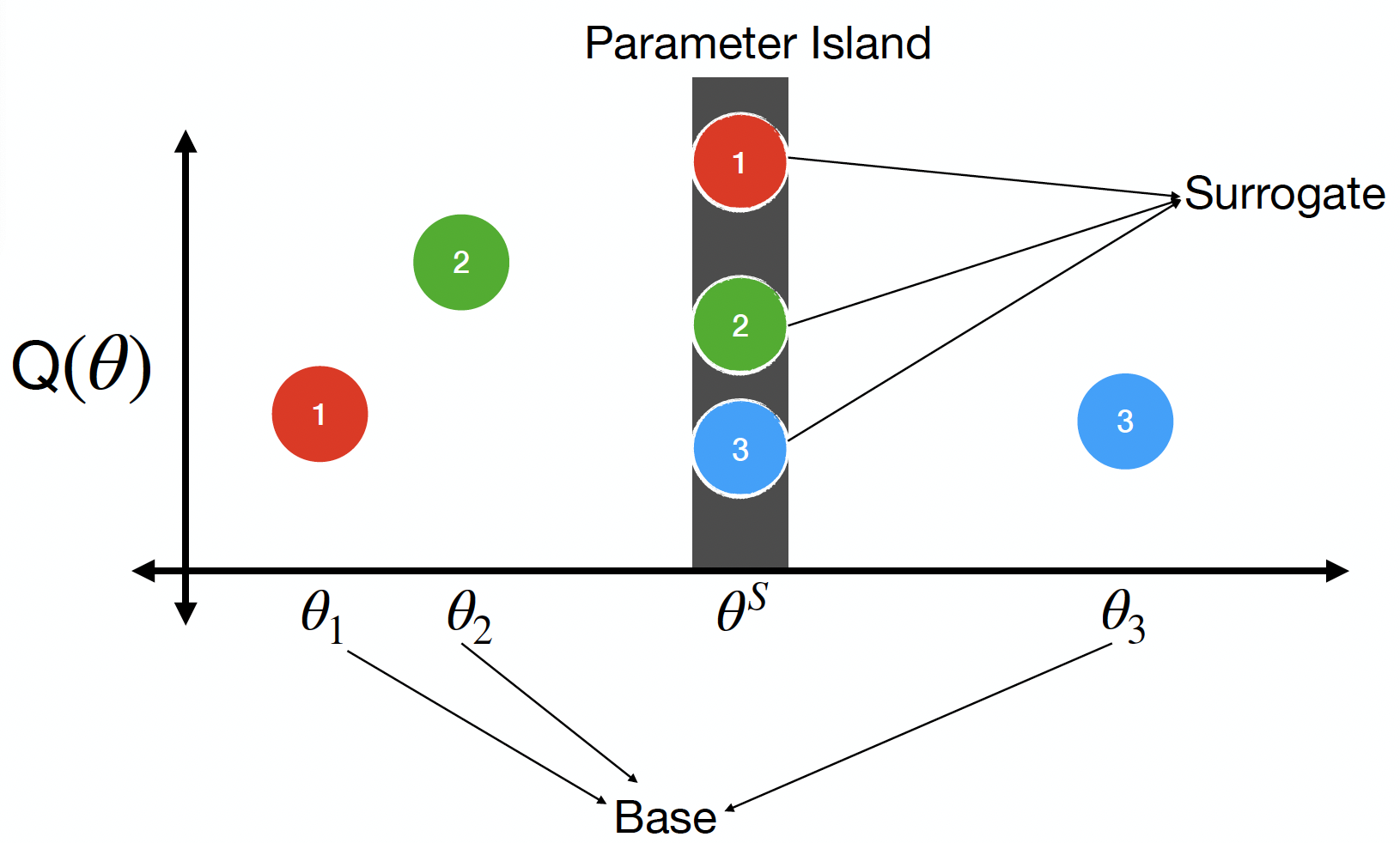
We present a simplistic picture of the CARPoolGP sampling method In the above figure. We show three base samples spread through a one-dimensional parameter space with some associated noisy quantity \(\tilde{Q}(\theta_i)\). Surrogate samples live on the parameter island, shown as the black bar, located at \(\theta^S\). A base-surrogate pair, which has correlated sample noise realizations, is shown by samples with matching numbers. The colors show how surrogates from the parameter island can maintain some conception of their variation at the parameter island (e.g., red is too high, blue is too low) and broadcast this to the base samples.